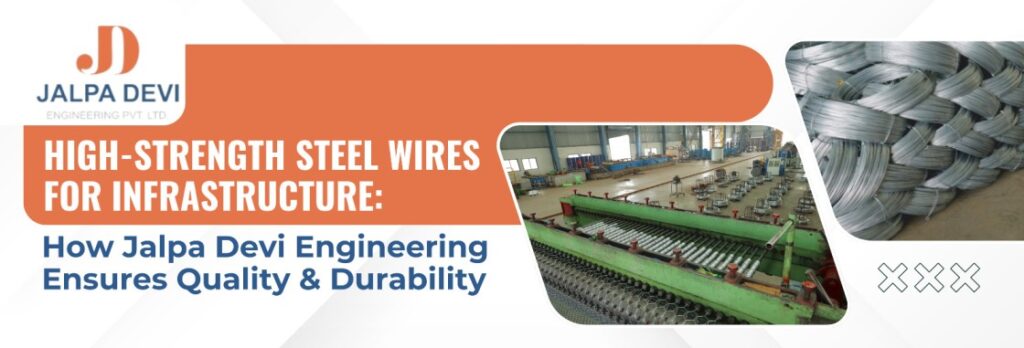
In today’s infrastructure-driven economy, high strength steel wires form the invisible backbone of bridges, highways, industrial structures, and power transmission systems. These slender yet robust components play a pivotal role in reinforcing modern construction with precision, endurance, and safety. At Jalpa Devi Engineering Pvt. Ltd., the manufacturing of infrastructure wires is more than an industrial process—it’s a commitment to engineering excellence. By combining advanced metallurgical science, automated fabrication lines, and rigorous quality testing, Jalpa Devi Engineering (JDEPL) has emerged as a trusted name in producing durable steel wire manufacturing solutions that meet global standards.
The Vital Role of High-Strength Steel Wires in Infrastructure
Every bridge suspended over a river, every flyover carrying tonnes of traffic, and every transmission tower battling wind and weather relies fundamentally on high-strength steel wires for structural integrity and balance. These steel wires act as critical tension members, bearing enormous tensile forces that keep the structures stable and functional under diverse stresses. Their high tensile strength allows them to carry heavy loads across long spans while maintaining flexibility to absorb vibrations and dynamic loads, essential for the durability of bridges and flyovers. Moreover, their fatigue resistance ensures long-term performance despite continual stresses from traffic and environmental factors, such as wind, temperature changes, and moisture. The corrosion resistance of these wires through protective coatings prolongs their service life, making them indispensable in infrastructure exposed to harsh weather conditions.
Specifically, high-strength steel wires find key applications in:
- Bridge cables and prestressed concrete girders: These wires are used as the main cables in suspension and cable-stayed bridges, where they carry immense load over large distances. In prestressed concrete girders, they provide the necessary tension to counteract bending forces, enabling longer spans and slimmer designs, ultimately reducing material use and cost.
- Reinforced earth walls and retaining systems: Steel wires stabilize slopes by reinforcing retaining walls, preventing soil erosion and landslides. Their strength resists earth pressure and environmental degradation, crucial in hilly terrain and infrastructure near waterways.
- Transmission and communication towers: These towers rely on high-strength wires as lightweight yet resilient tension members to withstand wind and mechanical forces while maintaining structural form, facilitating power and data transmission.
- Pre-tensioned and post-tensioned concrete applications: Across highways and railways, steel wires are embedded within concrete to enhance structural capacity. Pre-tensioned wires are stretched before concrete is poured, and post-tensioned wires are stressed after curing, enabling bridges and pavements to handle heavier loads and reduce cracking.
Such applications demand wires manufactured with unwavering precision, tight dimensional tolerances, and consistent mechanical properties. Jalpa Devi Engineering ensures this by employing advanced metallurgical processes, rigorous quality controls, and cutting-edge testing. This results in steel wires that consistently meet the demanding performance criteria essential for the safety and durability of critical infrastructure projects.
Jalpa Devi Engineering: The Legacy of Strength and Innovation
Founded in 2018 in Pithampur, Madhya Pradesh, Jalpa Devi Engineering Pvt. Ltd. was established with the vision of supporting India’s infrastructure revolution through advanced engineering solutions. The company’s infrastructure facility spans over 61,000 sq. meters, incorporating wire manufacturing, heavy fabrication, casting, and precision machining units under one roof. This holistic ecosystem empowers JDEPL to oversee every stage of production—from raw material evaluation to final product dispatch. At Jalpa Devi Engineering Pvt. Ltd., infrastructure wire manufacturing is driven by advanced metallurgical science, automated fabrication lines, and rigorous testing standards.
The company stands apart due to:
- In-house R&D and Testing Laboratories ensuring each wire meets IS, BS, ASTM, and DIN standards.
- Modern Wire Plants with automated drawing mills and annealing furnaces.
- Customized Manufacturing for varying tensile strength, diameter, and application-specific coatings.
JDEPL’s promise is simple yet powerful: to deliver wires that perform with uncompromising reliability under even the harshest conditions.
Material Science Behind High-Strength Steel Wires
The manufacturing of high-strength steel wires at Jalpa Devi Engineering is a meticulous and advanced process, emphasizing metallurgical precision and strict quality control to ensure durability and performance. Here is a detailed explanation of each point involved in the process:
1. Wire Rod Preparation
The process begins with selecting high-quality alloy steel billets, which serve as the raw material for wire production. These billets are carefully chosen based on their chemical composition to ensure they possess the necessary strength, ductility, and corrosion resistance required for infrastructure applications. The billets are then heated uniformly to prepare them for further processing.
2. Cleaning & Pickling
Before drawing the wire, the steel billets undergo cleaning and pickling. This surface treatment removes any scales, oxides, and impurities resulting from casting or hot rolling. Ensuring a clean surface is critical to achieving a smooth drawing process, preventing defects, and maintaining the integrity of the final wire. Pickling typically involves acid baths or environmentally friendly alternatives that ensure surface readiness for the next stage.
3. Cold Drawing
Cold drawing is a controlled process where the steel rod is pulled through a series of precision dies to reduce its diameter gradually. This step refines the wire’s internal grain structure, significantly enhances its tensile strength, and improves its surface finish. Multiple passes through the dies allow for precise control of mechanical properties, ensuring the wire meets specific tensile strength, ductility, and elongation requirements vital for infrastructure use.
4. Heat Treatment & Annealing
Post-drawing, the wires undergo heat treatment processes such as annealing or stress relieving. These steps restore ductility lost during cold drawing, relieve internal stresses, and refine the internal grain structure, making the wire easier to handle and more resistant to fatigue. Proper heat treatment enhances the wire’s ability to withstand cyclic loads and environmental stressors, which is critical for infrastructure applications exposed to varying conditions.
5. Galvanization or Coating
To prevent corrosion—especially crucial for outdoor and high-moisture environments—the wires are coated with protective layers such as zinc (galvanization) or other environmentally resistant coatings known as Galvanized steel wire. This surface protection ensures the long-term durability of the steel wire, preventing rust and deterioration due to weathering, humidity, and chemical exposure. The coating process is carefully controlled to provide uniform coverage and adhesion.
6. Rigorous Monitoring and Quality Control
Throughout each stage, Jalpa Devi Engineering employs advanced monitoring techniques. Dimensional measurements, tensile testing, and surface inspections are performed regularly to ensure that every wire conforms to international and national standards. Non-destructive testing methods such as ultrasonic inspection and surface defect analysis further verify structural integrity and surface quality. This unwavering focus on quality control guarantees that the final product possesses the high strength, durability, and reliability essential for infrastructure applications.
Engineering for Durability & Performance
When it comes to durable steel wire manufacturing, longevity is not just a feature—it’s an obligation. Jalpa Devi Engineering focuses on creating wires that maintain their structural integrity across years of service. Through non-destructive testing (NDT), fatigue analysis, and surface inspection, only wires that meet the company’s stringent benchmarks proceed for dispatch.
The plant leverages cutting-edge testing methods:
- Tensile and Yield Testing using servo-controlled hydraulic systems.
- Fatigue Resistance Evaluation simulating high-cycle load scenarios.
- Salt Spray Testing for accelerated corrosion assessment.
- Bend and Twist Testing to ensure flexibility without cracking.
These processes reinforce Jalpa Devi’s reputation for producing infrastructure wires that thrive in India’s harsh climatic conditions—including coastal regions, high altitudes, and humid terrains.
Infrastructure Wires that Power the Nation
Jalpa Devi’s infrastructure wires serve as foundational elements in multiple national development projects—bridges, metro systems, river crossings, industrial facilities, and more. By supplying materials to both public and private sectors, the company contributes significantly to India’s urban and rural connectivity.
Some key applications include:
- Suspension Bridge Cables: Where tensile load capacity and fatigue endurance are vital.
- Flyover Reinforcement Wires: Used in tendons for prestressed concrete operations.
- Dam and Irrigation Projects: High-tensile galvanized strands resist moisture and corrosion.
- Transmission and Telecom Structures: Wires balanced between strength and conductivity.
- Gabion and Retaining Structures: Wires coated with zinc or PVC for extended lifespan.
The combination of engineering precision and material adaptability ensures that every Jalpa Devi product contributes to India’s sustainable growth
Excellence Through Technology and Automation
Modern wire manufacturing is a symphony of automation and precision, and Jalpa Devi Engineering’s production line embodies this philosophy. Its CNC-controlled drawing lines, robotic winding systems, and laser-assisted measurement tools ensure zero human error in critical operations. Continuous monitoring of wire diameter, surface finish, and tensile value ensures performance reproducibility across batches.
This commitment to Industry 4.0 principles allows JDEPL to:
- Achieve dimensional accuracy within ±0.02 mm.
- Minimize defect rates through real-time statistical process control.
- Enable just-in-time delivery through predictive maintenance and digitally managed logistics.
- Integrate IoT-based dashboards that track quality and production efficiency.
Technology-driven excellence ensures that Jalpa Devi Engineering remains ahead in both domestic and international markets.
Sustainability and Green Manufacturing Practices
True engineering leadership reflects not only in strength but also in responsibility. Jalpa Devi Engineering takes pride in advancing eco-efficient wire manufacturing practices that minimize carbon footprints while maximizing output quality. The company employs:
- Closed-loop water systems for cooling and cleaning to prevent wastage.
- Energy-efficient annealing furnaces with recuperative heat exchangers.
- Use of recycled and certified raw materials in compliance with ISO 14001 standards.
- Environment-friendly coatings like non-toxic zinc-aluminum alloys.
These steps form part of a greater mission—to ensure that durability extends beyond the wire, to the planet itself.
Collaboration and Quality Assurance
Beyond materials and machinery, Jalpa Devi Engineering’s strength lies in its people and partnerships. Collaboration with civil engineers, project consultants, and global material scientists ensures constant evolution in the company’s product portfolio. Every batch of high-strength steel wire undergoes certification to national and international benchmarks including:
- IS 4454 (Part I-II) for tensile properties and wire classification.
- ASTM A421 / A416 for prestressed concrete applications.
- BS EN 10138 for load relaxation and fatigue resistance.
This integrated approach secures JDEPL’s standing as a dependable supplier for mission-critical infrastructure work.
Empowering Infrastructure with Confidence
Across bridges, highways, power stations, and high-rise buildings, Jalpa Devi’s infrastructure wires symbolize trust and innovation. Their consistency in strength and resilience underscores India’s ambitions for world-class connectivity. The company’s commitment to timely delivery, certified testing, and customized engineering enables clients to build safer, more durable, and cost-effective structures.
By balancing quality with scale, Jalpa Devi Engineering demonstrates how Indian manufacturing can meet and exceed global expectations—bridging the gap between traditional craftsmanship and modern innovation.
The Road Ahead: Expanding Horizons
Moving forward, Jalpa Devi Engineering is poised to reinforce its leadership in wire technology with continuous R&D in metallurgical sciences, automation-enabled precision, and expanded production capacity. The company aims to explore:
- Carbon-neutral wire manufacturing practices.
- Export partnerships across Asia, Africa, and the Middle East.
- Integration of AI-based predictive analysis for real-time process optimization.
- Training academies for skilled labour and innovation-focused engineers.
By aligning with “Make in India” and sustainable development goals, Jalpa Devi Engineering envisions a future where its steel wires support not just physical structures—but also the aspirations of a progressive nation.
Conclusion
In essence, high-strength steel wires are silent enablers of the modern world—supporting the very framework of progress and innovation. At Jalpa Devi Engineering Pvt. Ltd., every spool of wire represents decades of metallurgical insight, uncompromising quality, and an unyielding pursuit of excellence. From design to dispatch, every strand passes through rigorous checks to ensure it can withstand the test of time, load, and nature.
With an unwavering focus on quality, durability, and sustainability, Jalpa Devi Engineering continues to redefine standards in durable steel wire manufacturing. Each wire it produces is not merely a product—it’s a promise of strength woven into India’s growing infrastructure legacy.