Reliability, productivity, and cost-efficiency — these three pillars define the success of every aggregate and mining operation. At the core of achieving these lies one of the industry’s most vital machines — the cone crusher. This powerful piece of equipment is designed to take on the toughest materials, converting large rocks and ores into uniform, valuable aggregates.
Yet, what truly determines a cone crusher’s performance and longevity are not just its design or size — but the wear parts that do the hard work inside it. Among these, the mantle and concave (bowl liner) form the heart of the machine.
Understanding how these parts function, how they wear, and how quality and maintenance affect their lifespan can mean the difference between smooth, efficient production — or costly, unplanned downtime. Let’s dive deep into the anatomy of a cone crusher and uncover how mantles and concaves keep your operation running seamlessly.
What Are Mantles and Concaves?
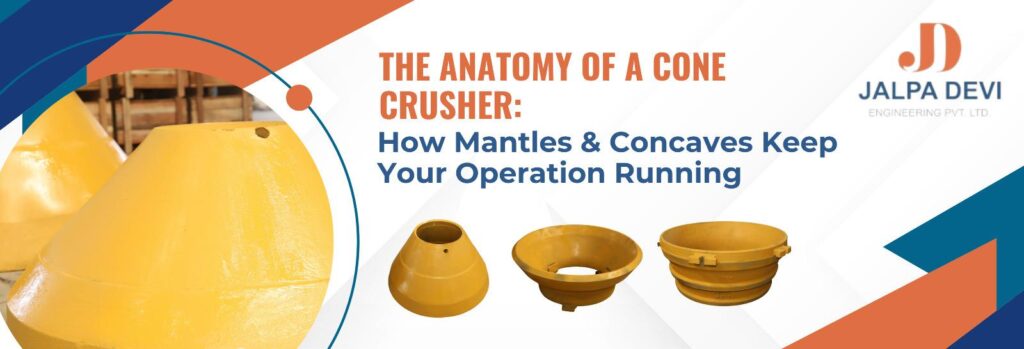
Inside every cone crusher lies a pair of wear parts that take the brunt of the crushing action — the mantle and the concave.
- The Mantle: This is a heavy, cone-shaped steel casting that fits over the main shaft. It’s the moving part of the crusher, gyrating inside the chamber.
- The Concave (or Bowl Liner): This fixed liner is mounted inside the main frame of the crusher. Together with the mantle, it creates the crushing chamber where the magic happens — or rather, where the rock meets its end.
When the machine is running, the mantle gyrates within the concave, constantly moving closer and farther away. This repetitive motion applies compressive forces that break rocks along their natural fracture lines, transforming raw feed into usable aggregates.
The Crushing Chamber: How It Works
To understand the significance of these wear parts, it helps to visualize the process.
The cone crusher’s crushing chamber is a tapered space between the moving mantle and the stationary concave. When the machine operates:
- Feed Entry: Material enters from the top of the crusher.
- Compression Phase: As the mantle moves toward the concave, the material is compressed and crushed.
- Discharge Phase: When the mantle moves away, the smaller, broken particles fall downward and exit through the bottom.
The Closed Side Setting (CSS) — the smallest gap between the mantle and concave — determines the size of the output product. The Open Side Setting (OSS), on the other hand, defines the largest particle that can pass through.
By continuously cycling between compression and release, the crusher maintains a steady flow of material — a process both efficient and powerful.
Why Mantles and Concaves Matter
Mantles and concaves are not just wear parts — they are performance parts. Their shape, metallurgy, and fit directly influence:
- Crushing efficiency
- Product size consistency
- Power consumption
- Throughput and capacity
- Downtime frequency
Even a minor deviation in their profile can alter the crushing dynamics, leading to reduced output, uneven wear, and increased operational costs. That’s why precision engineering and quality materials are essential in manufacturing these components.
Typical Causes of Wear in Cone Crusher Wear Parts
The crushing chamber faces extreme conditions — high pressure, constant vibration, and continuous impact from abrasive materials. Over time, this results in wear. Understanding why mantles and concaves wear out helps prevent premature failure.
a. Abrasion
This is the most common cause. As hard rock fragments move between the mantle and concave, they grind against the steel surfaces, gradually thinning the liners. Materials rich in silica or quartz accelerate this process, leaving smooth, grooved wear patterns.
b. Impact
When oversized feed or tramp metal enters the crusher, the sudden force can chip, crack, or even break the liners. Maintaining consistent feed size and installing metal detectors can help prevent this damage.
c. Fatigue
Repeated cycles of compression and release cause micro-cracks to form in the liner material. Over time, these propagate and result in spalling or surface flaking.
d. Incorrect Operating Conditions
Improper feed distribution, incorrect CSS settings, or running the crusher underfilled or overloaded can cause uneven wear, localized hotspots, or premature liner failure.
In short: even the toughest materials wear down — but how fast they do depends on how you operate and maintain the machine.
The Science Behind Material Selection
The material of your cone crusher wear parts determines their strength, toughness, and service life. For decades, manganese steel has been the industry standard — and for good reason.
Why Manganese Steel Rules the Industry
- Work Hardening Property:
Manganese steel becomes stronger the more it’s used. Under pressure and impact, its surface hardens while the inner structure remains tough and ductile. This dual property makes it ideal for high-impact, high-friction applications like crushing. - Excellent Fracture Toughness:
Unlike brittle alloys, manganese steel can absorb shock without cracking — a critical factor in protecting crushers from catastrophic liner failure. - Customizable Grades:
Manganese steel comes in different compositions (commonly 13%, 18%, and 21% Mn). Higher manganese content offers better wear resistance for harder, more abrasive materials. - Adaptability:
Depending on the ore type and operating conditions, manufacturers can modify the chemical composition to optimize performance — balancing toughness and wear resistance.
For especially abrasive environments, alloyed steels or high-chrome iron liners may be used. However, for most aggregate and mining operations, manganese steel offers the best cost-performance balance.
Design and Profile Engineering: The Hidden Advantage
Beyond metallurgy, the design of the mantle and concave — specifically their profile — plays a crucial role in performance.
Correct Chamber Profile = Maximum Productivity
- Steep profiles are ideal for fine crushing applications, offering better particle shape and high reduction ratios.
- Shallower profiles work best for secondary crushing, where high throughput and larger feed sizes are priorities.
Manufacturers like JALPA Engineering Pvt. Ltd. design and optimize profiles through 3D scanning, simulation, and field feedback, ensuring each set of wear parts aligns perfectly with your specific crushing chamber and feed characteristics.
Benefits of Optimized Profiles:
- More uniform wear distribution
- Reduced energy consumption
- Better product shape
- Longer liner life
- Increased overall crusher efficiency
In essence, good design turns durable materials into long-term performance.
Maintenance & Best Practices for Longevity
Even the best materials need proper maintenance to perform. Here’s how to extend the life of your cone crusher wear parts:
1. Routine Inspections
- Check liners during every service interval.
- Look for uneven wear, cracks, or distortions.
- Inspect locking bolts, seating surfaces, and backing compound conditions.
2. Measure and Monitor Wear
- Use CSS gauges and ultrasonic thickness testers to measure liner thickness at multiple points.
- Keep an eye on discharge size — a sudden coarsening of product may indicate excessive liner wear.
- Ensure correct mantle seating and mainframe contact to avoid misalignment.
3. Replace at the Right Time
- Replace liners before the profile becomes too shallow. Overworn liners reduce crushing efficiency, increase power consumption, and risk damaging the main components.
- Always replace mantle and concave together to maintain correct chamber geometry.
- Use OEM-quality or certified parts — precision fit and correct metallurgy directly impact performance and safety.
4. Optimize Operating Parameters
- Maintain consistent feed distribution — uneven feed causes localized wear.
- Avoid running at low power draw for extended periods — this reduces crushing pressure and leads to uneven liner wear.
- Periodically adjust CSS to balance throughput and product size.
5. Record and Review
- Keep detailed logs of liner life, wear rates, and operational parameters.
- This data helps identify patterns and optimize future liner design and material selection.
By combining proactive maintenance with data-driven insights, operators can significantly reduce downtime and maximize output.
The Economics: How Quality Wear Parts Save Cost per Ton
Every crushing operation measures success by cost per ton — how much it costs to produce one ton of finished product. Wear parts play a surprisingly large role in that equation.
Investing in High-Quality Cone Crusher Wear Parts Yields:
a. Longer Wear Life
Premium manganese liners resist deformation and wear longer, extending replacement intervals and reducing labor costs.
b. Reduced Downtime
Fewer liner changes mean more production hours — and in mining, every hour counts.
c. Consistent Product Quality
When liners maintain their original profile longer, the crusher produces a more uniform, cubical product, ideal for high-spec concrete and road applications.
d. Lower Energy Consumption
Efficient crushing reduces power draw. Fresh, properly profiled liners require less energy to achieve the same reduction ratio.
e. Fewer Secondary Failures
Inferior or misfitted liners can cause vibrations, imbalance, or mainshaft wear — leading to expensive repairs. High-quality liners minimize these risks.
In other words — quality liners pay for themselves many times over their lifespan.
Partnering with the Right Manufacturer Matters
The value of cone crusher wear parts goes beyond their physical form. Partnering with a reliable manufacturer like JALPA Engineering Pvt. Ltd. ensures:
- Precision Casting:
Each mantle and concave is cast to exacting standards for perfect fit and performance. - Metallurgical Expertise:
JALPA uses advanced manganese alloys and controlled heat treatment processes to deliver exceptional toughness and wear resistance. - Customized Design Support:
From profile optimization to chamber redesign, JALPA’s experts collaborate with clients to solve specific site challenges. - Quality Assurance:
Every product undergoes rigorous testing — chemical composition analysis, hardness checks, and dimensional accuracy verification. - After-Sales Service:
Technical support and wear analysis help clients maximize part life and plan replacements proactively.
Choosing a trusted manufacturer ensures that your investment in wear parts translates into real operational gains — not just replacement parts, but performance solutions.
Future Trends in Cone Crusher Wear Parts
The industry is evolving — and so is the science of wear parts. Innovations are reshaping how mantles and concaves perform in the field:
- Composite Liners: Combining manganese with ceramic inserts or carbide layers for ultra-high abrasion resistance.
- Digital Wear Monitoring: Sensors and AI analytics to predict liner life and schedule changeouts automatically.
- 3D Scanning for Chamber Mapping: Allowing precise wear tracking and custom redesign for each site.
- Sustainable Foundry Practices: Energy-efficient casting and recyclable alloys aligning with environmental goals.
Manufacturers like JALPA are at the forefront of adopting such technologies — ensuring not just durability, but also sustainability and smarter maintenance.
Common Myths About Cone Crusher Wear Parts
Let’s debunk a few misconceptions often heard in the field:
- Myth 1: All manganese liners are the same.
Reality: The composition, heat treatment, and quality control differ vastly between manufacturers. Cheap liners often cost more in the long run. - Myth 2: You can mix old and new liners.
Reality: This causes misalignment, uneven wear, and possible damage. Always replace mantles and concaves as a pair. - Myth 3: Harder steel always lasts longer.
Reality: Hardness without toughness leads to brittleness and cracking. Balance is key. - Myth 4: Maintenance doesn’t affect wear life.
Reality: Poor feed conditions, incorrect settings, or infrequent inspections drastically shorten liner lifespan.
Knowing the truth helps operators make smarter, safer, and more cost-effective choices.
Conclusion
The mantle and concave are more than just consumable wear parts — they are the operational heartbeat of every cone crusher. Together, they determine not only the quality of the crushed product but also the efficiency, reliability, and profitability of the entire plant.
By understanding how they function, choosing the right material and profile, and maintaining them with discipline, you can unlock exceptional performance and longevity from your equipment.
At JALPA Engineering Pvt. Ltd., we combine advanced metallurgy, precision engineering, and deep field experience to deliver high-performance cone crusher wear parts that maximize uptime, minimize cost per ton, and keep your operation running at full capacity.
Because in mining and aggregates, every ton counts — and every detail matters.